
Servo hydraulic presses are advanced machines designed to deliver precise control of force, speed, and position through closed-loop servo systems. By integrating servo motors and intelligent hydraulic control, these presses provide high accuracy, repeatability, and energy efficiency compared to conventional hydraulic presses. Their robust construction ensures stable performance, making them suitable for continuous industrial operation as well as precision laboratory environments.
Mechanical Testing Equipment
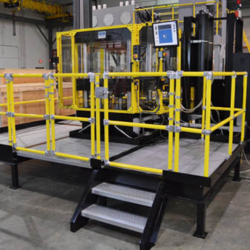
Hydro Forming Press Machines
Hydro Forming Press Machine Suppliers in India
Interlaken Technology has been designing and manufacturing exclusive hydroforming systems for over 20 years. From a 50 Ton hydroforming press for university research to a 2000 Ton production press for manufacturing, ITC’s hydroforming systems fill a variety of needs.
The ITC press optimizes tube forming. Tube hydroforming reduces weight, reduces component part count, lowers assembly costs, and increases strength and stability. The system features mode switching from stroke to pressure feedback for control, and complete independent control of clamp, feeds, and pressure. This results in a highly repeatable process to maintain tight tolerances.
Category:
Customers may choose from one of our standard hydroforming systems or ITC can build an optimized solution for your specific application. ITC presses provide closed loop control of forces, motions and pressures to produce high quality parts. Our exclusive, easy-to-use software allows users to develop complex force, motion and pressure profiles for consistent tube forming applications.
The system is comprised of five sub-systems:
- A single or multi-acting, servo-controlled hydraulic press with mode switching during the process.
- Servo-controlled Hydroforming Feed Actuators that are fully integrated.
- A Servo-controlled Pressure Intensifier with pressure control valves. A variety of pressure and flow options are available.
- Interlaken designed tooling with changeable die inserts for differing cavity shapes that can be run with or without end feed.
- A B&R PC that controls the PLC I/O and HMI.
High-precision servo hydraulic control for accurate forming.
Closed-loop pressure and motion monitoring.
Independent clamp, feed, and pressure control.
High-pressure intensifier for complex shapes.
Automation-ready and customizable design.
Real-time data acquisition and monitoring.
High repeatability with tight tolerances.
Reduced weight and fewer weld joints.
Machine Capacity
Press Capacity: 50 Ton to 2000 Ton
Tube Diameter Range: 10 mm to 300 mm (customizable)
- Maximum Tube Length: Up to 6 meters (application dependent)
Pressure System - Internal Forming Pressure: Up to 4000 bar
- Servo-controlled Pressure Intensifier
- Closed-loop pressure control with high accuracy
Hydraulic Press System
- Single or Multi-acting Servo Hydraulic Press
- Mode switching: Stroke control to Pressure control
- High rigidity frame for tight tolerances
Feed System
- Servo-controlled End Feed Actuators
- Independent Clamp and Feed Control
- Adjustable feed speed and displacement
Control System
- B&R PC-based PLC with HMI Interface
Closed-loop control of force, motion, and pressure - Programmable forming profiles
- Data logging and repeatability control
Tooling System
- Interchangeable die inserts
- Custom tooling for different cavity shapes
- Supports forming with or without end feed
Accuracy & Repeatability
- Tight tolerance tube forming
- High repeatability for production use
- Automatic process monitoring
- Safety Features
- Pressure overload protection
Emergency stop and safety interlocks
Hydraulic safety valves
Automotive chassis components
Exhaust system partsEngine cradles & subframes
Aerospace structural tubingBicycle & motorcycle framesHVAC ducting component frames
Furniture tubular structures
Fluid manifolds & connectors
Lightweight structural assemblies
1. What is hydroforming?
Hydroforming is a metal forming process that uses high-pressure fluid to shape tubes or sheets into complex components.
2. What materials can be hydroformed?
Common materials include steel, stainless steel, aluminum, copper, brass, and special alloys.
3. What industries use Interlaken hydroforming systems?
Automotive, aerospace, HVAC, oil & gas, medical, and research laboratories.
4. What is the advantage of hydroforming over welding?
It reduces part count, improves strength, lowers weight, and provides better dimensional accuracy.
5. What is the typical forming pressure?
Hydroforming systems can operate up to about 30,000 psi depending on the application.
6. What size parts can be formed?
Small lab parts to large production tubes, depending on press capacity and tooling.
7. Are Interlaken systems customizable?
Yes, machines can be designed for specific applications, part sizes, and automation needs.
8. Do these machines support automation?
These machines use advanced PLC or CNC-based servo-hydraulic control systems with closed-loop feedback for precise control of pressure, force, displacement, and cycle timing, ensuring high repeatability and safety during operation.