
Mechanical Testing Equipment
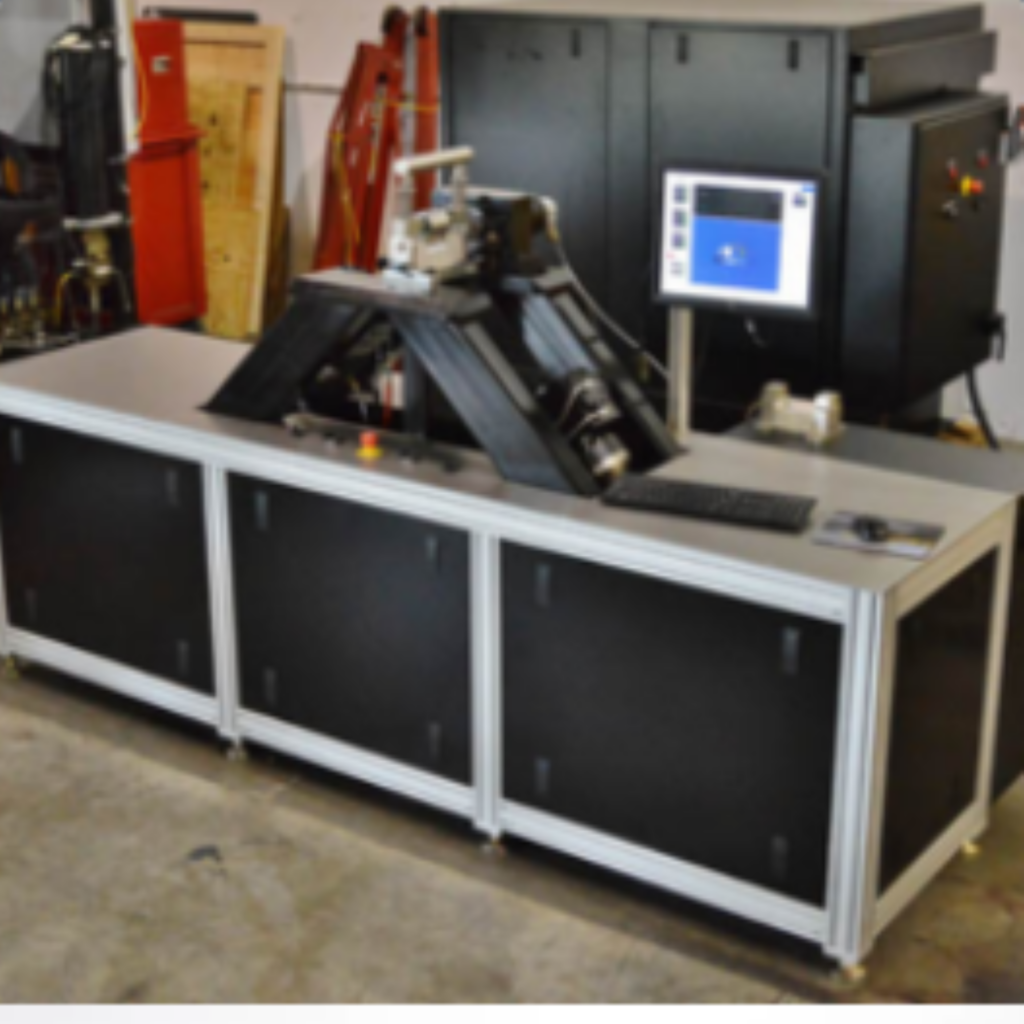
Interlaken 90 ° Bend Tester
Interlaken Technology 90° Bend Tester Machine Suppliers
Interlaken 90° Bend Tester Press Machine is a precision material testing device designed to evaluate the bendability, ductility, and structural integrity of metals, sheets, plates, and bars. It allows manufacturers, quality control teams, and research laboratories to perform standardized 90° bend tests under controlled conditions, ensuring materials can withstand bending without cracking, deforming, or failing.
Category:
Interlaken Servo press hydraulic 90° Bend Tester Machines The Interlaken 90° Bend Tester Press Machine is an essential tool for industries and labs that require precision bending tests, reliable material evaluation, and enhanced quality assurance.
This machine applies a controlled bending force to the test specimen using a robust press mechanism. The specimen is bent to a precise 90° angle, and the machine helps assess critical parameters such as springback, ductility, deformation, and material strength. It is widely used in industries like automotive, appliance manufacturing, metal fabrication, construction, and coatings, where accurate bending performance is essential.
- High-precision bending for accurate and repeatable 90° angle tests.
- Supports a variety of specimens including sheets, plates, and bars.
- Adjustable die and support settings for different thicknesses and sizes.
- Robust, heavy-duty construction for long-term stability and durability.
- Controlled hydraulic or mechanical loading for uniform bending.
- Easy-to-use operation suitable for both laboratories and production floors.
- Safety features including specimen clamps and overload protection.
- Compliant with standard testing protocols for material bend testing.
Interlaken hydroforming press machines are available in a wide range of tonnage capacities starting from small laboratory systems around 50 tons to heavy industrial presses exceeding 2000 tons. These systems support high-pressure forming operations typically ranging from several hundred bar to above 4000 bar depending on application requirements. The machines are compatible with a wide range of materials including mild steel, stainless steel, aluminum alloys, titanium, copper, and special high-strength alloys. Tube diameter, wall thickness, stroke length, and press bed size can be custom engineered as per customer requirements. The control system supports PLC or CNC-based integration with real-time pressure, force, displacement, and cycle monitoring.
- Material quality verification for automotive panels, appliance parts, and structural components.
- R&D testing for new alloys, coated materials, and laminated sheets.
- Production quality control to ensure consistent bend performance.
- Compliance testing for industry standards and customer specifications.
Advantages
Ensures consistent, repeatable, and accurate bend test results.
Helps prevent material failure and reduces scrap in manufacturing.
Optimizes material selection and process parameters for bending operations.
Suitable for both small laboratory samples and larger production components.
1. What is the purpose of this machine?
It tests the bendability and ductility of metals, sheets, and plates by bending them to a precise 90° angle.
2. Which industries use it?
Automotive, appliance manufacturing, metal fabrication, construction, and coatings industries.
3. Can it handle different specimen sizes?
Yes, the machine has adjustable dies and supports to accommodate various thicknesses and sizes.
4. What materials can be tested?
Metal sheets, plates, bars, laminated materials, and coated surfaces.
5. How accurate is the bending test?
It provides precise and repeatable results, ensuring consistent evaluation of ductility and springback.
6. Is it suitable for R&D and production testing?
Yes, it is designed for both laboratory research and industrial quality control applications.
7. What safety features does it have?
It includes specimen clamps, overload protection, and a stable heavy-duty frame.
8. What does it measure?
Bend angle, springback, material deformation, ductility, and structural integrity.
9. How does it improve manufacturing quality?
By detecting material weaknesses early, it reduces scrap and ensures components meet bendability standards.
10. Is it easy to operate?
Yes, the machine is user-friendly and requires minimal training to operate safely and efficiently.