
Other Mechanical Testings
We have extensive experience across a wide range of industries
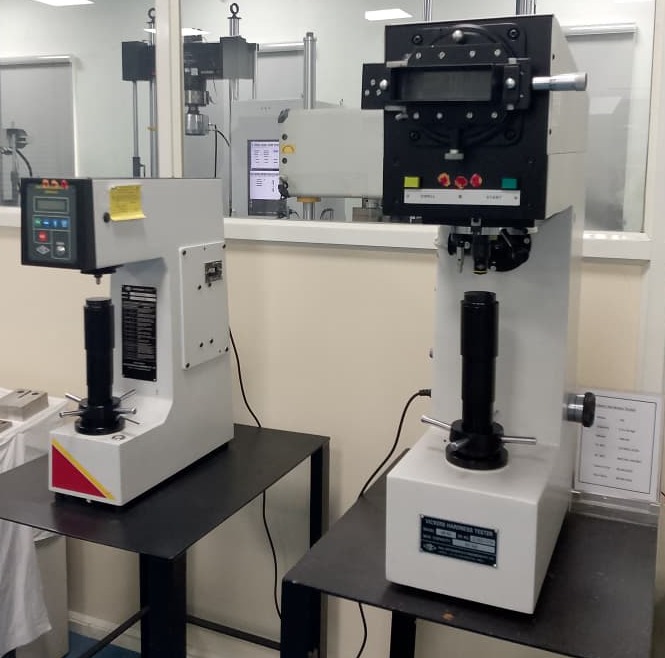
What is Hardness?
Hardness is the ability of a material to resist deformation, indentation, or scratching when a force is applied. It is one of the most important mechanical properties that determine how well a material can withstand wear, abrasion, and mechanical stress in real-world applications.
Why Hardness Testing is Important
Hardness testing helps in evaluating the strength, durability, and quality of materials. It is commonly used in industries such as aerospace, automotive, construction, and manufacturing to ensure materials meet required standards and performance expectations.
Key benefits include:
- Ensures material quality and consistency
- Helps in selecting suitable materials for specific applications
- Detects surface treatment effectiveness (like heat treatment or coating)
- Determines wear resistance and durability
Types of Hardness Tests
Several standard methods are used to measure hardness depending on the type of material and application:
Brinell Hardness Test (BHN) – Used for metals and alloys; involves pressing a hard ball into the material.
Rockwell Hardness Test (HR) – Fast and widely used; measures depth of indentation under load.
Vickers Hardness Test (VHN) – Uses a diamond pyramid indenter; suitable for thin materials and coatings.
Knoop Hardness Test – Ideal for microhardness testing on small components or thin layers.
Shore Hardness Test – Commonly used for rubber, plastics, and softer materials.
Applications of Hardness Testing
- Metal and alloy testing
- Heat treatment verification
- Quality control in manufacturing
- Research and development
- Coating and surface layer evaluation
Our Capabilities
At Measure India Corporation Pvt. Ltd., we provide precise hardness testing services using advanced equipment and certified standards. Our laboratory is equipped to perform Brinell, Rockwell, Vickers, and Micro Hardness tests on a wide range of materials including metals, polymers, and composites.
We ensure accurate, repeatable, and traceable results as per international standards such as ASTM, ISO, and IS specifications.
Hardness Testing – FAQs
Looking for Hardness testing services in India? Get accurate, NABL-certified material testing with advanced Universal Testing Machines (UTMs) today!
1. What is Hardness Testing?
Hardness testing is a method used to measure a material’s resistance to indentation, scratching, or deformation. It helps determine material strength, durability, and wear resistance.
2. What is the purpose of this test?
The most widely used hardness tests are Rockwell Hardness Test, Brinell Hardness Test, Vickers Hardness Test, and Knoop Hardness Test.
3. Why is hardness testing important?
Hardness testing ensures material quality, verifies heat treatment, checks wear resistance, and confirms compliance with standards before using materials in engineering applications.
4. Which industries use hardness testing?
Hardness testing is widely used in automotive, aerospace, construction, metallurgy, manufacturing, railways, and power industries.
5. What standards are followed for hardness testing?
Common standards include ASTM International, ISO, and Indian standards like Bureau of Indian Standards.
6. What materials can be tested for hardness?
Metals, alloys, plastics, ceramics, rubber, coatings, and composite materials can be tested depending on the testing method.
7. What is the difference between Rockwell, Brinell, and Vickers tests?
Rockwell gives direct readings quickly, Brinell is suitable for large coarse materials like castings, and Vickers is ideal for thin materials or micro-level testing.
8. How accurate is hardness testing?
Accuracy depends on machine calibration, operator skill, sample preparation, and proper test method selection.
Impact Testing
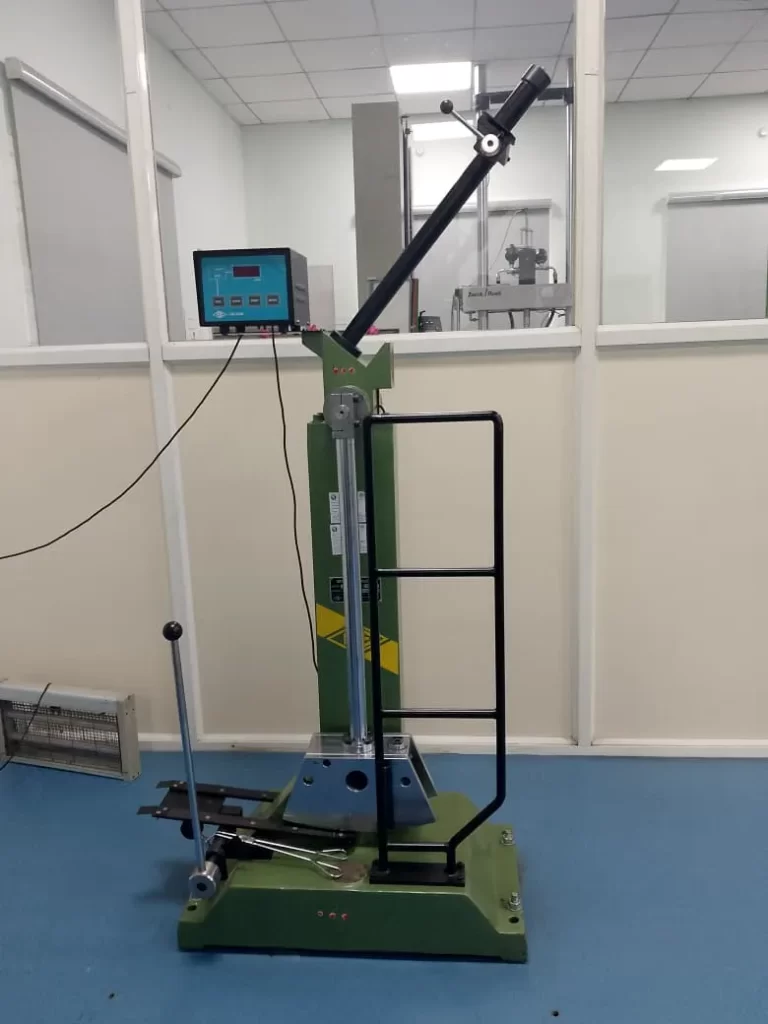
What is Impact Testing?
Impact testing measures a material’s ability to absorb energy during a sudden force or impact. It helps determine how tough or brittle a material is when subjected to dynamic loading conditions. This property is essential in ensuring that materials perform safely and reliably under real-life impact situations.
Purpose of Impact Testing
The main goal of impact testing is to study how materials behave under shock loading and to identify their toughness and ductility. It also helps in understanding how environmental conditions, such as low temperatures, can affect a material’s strength and fracture characteristics.
Types of Impact Tests
Charpy Impact Test
- The Charpy test uses a notched specimen struck by a pendulum hammer.
- The amount of energy absorbed by the material before fracture indicates its toughness.
- Commonly used for metals and alloys.
Izod Impact Test
- Similar to the Charpy test but the specimen is held vertically.
- Suitable for polymers, plastics, and metals.
Importance of Impact Testing
Evaluates material toughness and resistance to sudden shock.
Helps identify brittle or ductile behavior.
Ensures product safety and reliability under dynamic conditions.
Useful in quality control and research for material development.
Applications
Impact testing is widely used in industries such as:
- Automotive – crashworthiness and component durability.
- Aerospace – testing materials for structural reliability.
- Construction – evaluating steels and composites used in structures.
- Manufacturing – ensuring consistent material quality in production.
Our Impact Testing Capabilities
At Measure India Corporation Pvt. Ltd., we offer advanced Charpy and Izod Impact Testing as per ASTM, ISO, and IS standards. Our modern pendulum impact testers are designed for high accuracy and repeatability.
We provide testing services for a wide range of materials including metals, plastics, and composites — ensuring complete evaluation of toughness and impact resistance.
Impact Testing Sample Preparation – FAQs
Looking for testing services in India? Get accurate, NABL-certified material testing with advanced Universal Testing Machines (UTMs) today!
1. What is Impact Testing?
Impact testing measures a material’s ability to absorb energy during sudden shock or fracture. It evaluates toughness and resistance to brittle failure.
2. What are the common impact test methods?
The most widely used tests are Charpy Impact Test and Izod Impact Test.
3. Why is impact testing important?
It ensures materials can withstand sudden loads, vibrations, or crashes. It is critical for safety in structures, pipelines, pressure vessels, and automotive parts.
4. Which industries require impact testing?
Impact testing is used in aerospace, oil & gas, construction, automotive, railways, power plants, and heavy engineering industries.
5. What standards are followed for impact testing?
Common standards include ASTM International, ISO, and Bureau of Indian Standards such as ASTM E23 and IS 1757.
6. What materials can be tested in impact testing?
Metals, alloys, plastics, composites, and welded joints can be tested depending on the required standard.
7. What is the difference between Charpy and Izod tests?
Charpy test supports the specimen at both ends with impact in the center, while Izod test holds the specimen vertically as a cantilever and strikes at the notch.
8. What is ductile-to-brittle transition temperature (DBTT)?
DBTT is the temperature at which a material changes from ductile behavior to brittle fracture. Impact testing at different temperatures helps determine DBTT.
Rotary Bending Fatigue Testing
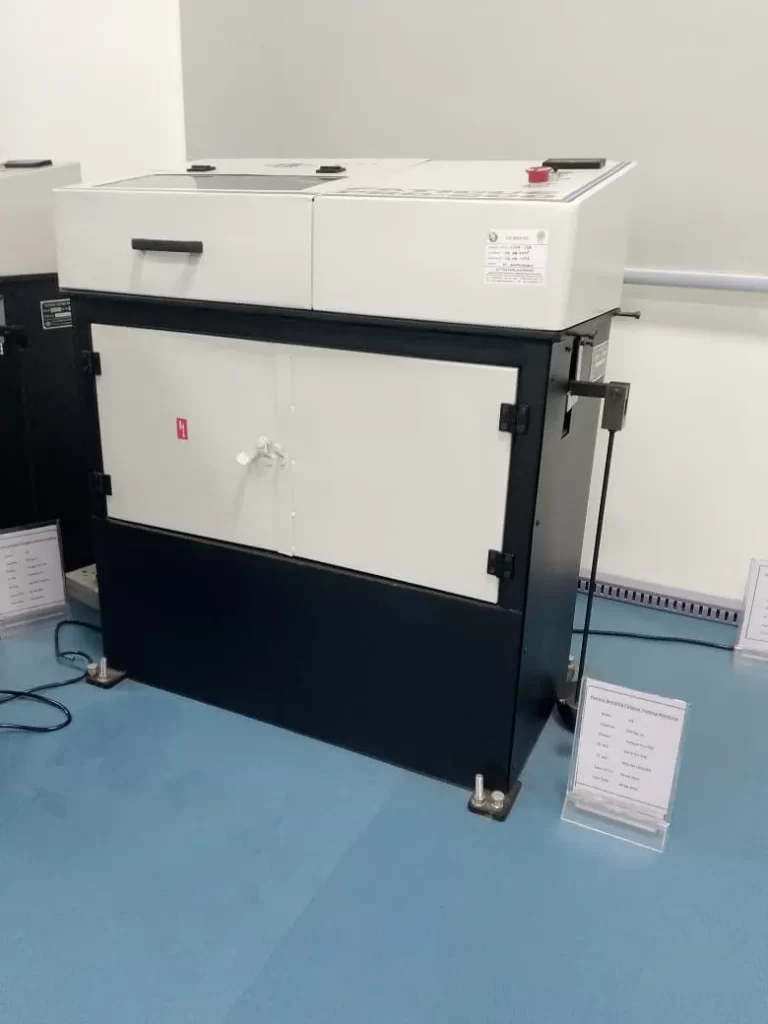
What is Rotary Bending Fatigue Testing?
Rotary Bending Fatigue Testing is a method used to determine a material’s resistance to cyclic or repeated stress. It evaluates how long a material can withstand continuous bending before failure occurs. This test helps predict the fatigue life of components that experience repeated loading in real-world conditions.
Purpose of the Test
The main goal of Rotary Bending Fatigue Testing is to understand the endurance limit — the maximum stress a material can endure for a specified number of cycles without breaking. It is crucial for ensuring that materials and components perform reliably under dynamic and fluctuating stresses over time.
How Rotary Bending Fatigue Testing Works
In this test, a cylindrical specimen is rotated at a constant speed while a bending moment is applied.
The specimen is subjected to tensile and compressive stresses alternately as it rotates.
The number of cycles to failure is recorded to determine the fatigue strength of the material.
Key Parameters Measured
- Fatigue strength (Stress vs. Number of Cycles – S-N Curve)
- Endurance limit
- Crack initiation and propagation behavior
- Material performance under cyclic loading
Applications of Rotary Bending Fatigue Testing
This test is widely used in various industries where parts are subjected to continuous motion or vibration, such as:
- Automotive: Crankshafts, connecting rods, axles, and gears
- Aerospace: Rotating shafts and turbine components
- Manufacturing: Springs, fasteners, and rotating machine parts
- Research & Development: Material fatigue analysis and life prediction
Our Rotary Bending Fatigue Testing Capabilities
At Measure India Corporation Pvt. Ltd., we provide high-precision Rotary Bending Fatigue Testing services for metals, alloys, and advanced materials.
Our testing setup includes:
- Fully computerized fatigue testing machines
- Variable load control and real-time data acquisition
- Testing as per ASTM E466, ISO 1143, and IS standards
- Experienced engineers for data interpretation and failure analysis
We deliver accurate, repeatable, and traceable results to help our clients improve product reliability, material design, and performance under real-life stress conditions.
Rotary bending Fatigue Testing Sample Preparation – FAQs
Looking for Rotary Bending Fatigue Testing testing services in India? Get accurate, NABL-certified material testing with advanced Universal Testing Machines (UTMs) today!
1. What is rotary bend fatigue testing?
It is a fatigue test where a cylindrical specimen rotates under a constant bending load until fracture, used to measure fatigue life.
2. What is the purpose of this test?
To determine fatigue strength, endurance limit, and number of cycles a material can withstand under repeated loading.
3. What type of stress occurs in rotary bending?
Fully reversed tensile and compressive stress (Stress ratio R = -1).
4. What materials are commonly tested?
Steels, aluminum alloys, titanium alloys, copper alloys, and other engineering metals used in shafts, fasteners, and springs.
5. Why is the specimen shaped like an hourglass?
To ensure failure occurs at the center where stress concentration is highest and results are accurate.
6. What industries use rotary bend fatigue testing?
Automotive, aerospace, railways, manufacturing, defense, and power sectors.
7. What standards are followed in rotary bending fatigue tests?
ASTM International – ASTM E466
International Organization for Standardization – ISO 1143
Bureau of Indian Standards – IS 5075
8. What is fatigue life?
Fatigue life is the total number of cycles a material survives before failure occurs.
Stress Corrosion Test
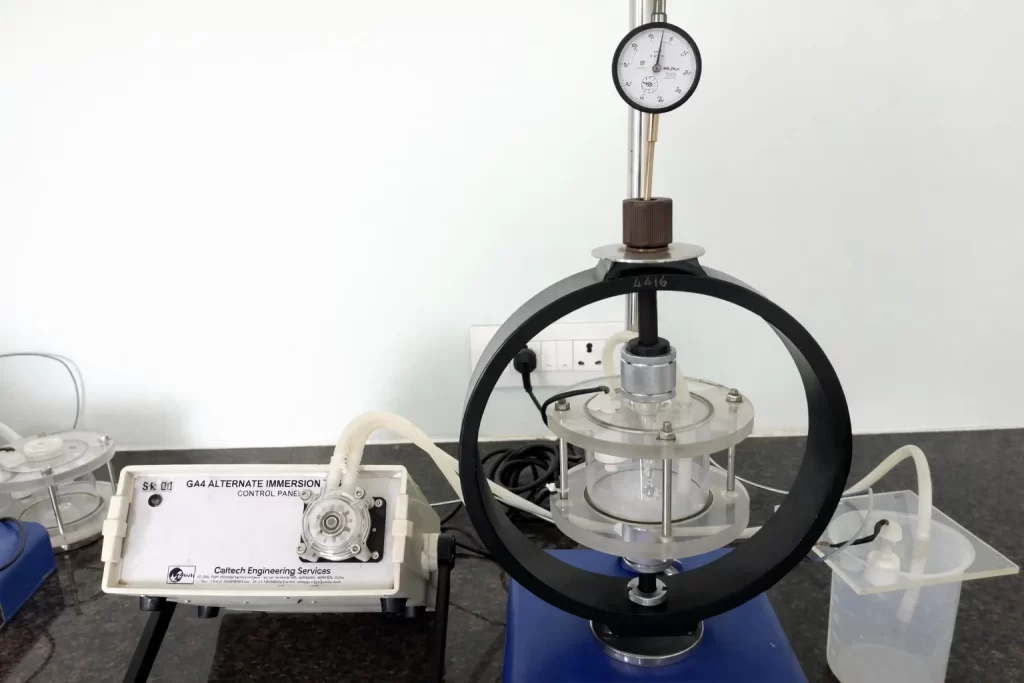
What is Stress Corrosion?
Stress corrosion is a material degradation process that occurs when a metal is exposed to a corrosive environment while simultaneously under tensile stress. This combination can lead to unexpected and sudden failures — even in materials that appear strong and corrosion-resistant under normal conditions.
The phenomenon is known as Stress Corrosion Cracking (SCC) and is especially dangerous because cracks can grow without significant deformation or warning.
Purpose of Stress Corrosion Testing
The main goal of Stress Corrosion Testing is to evaluate how materials behave under combined mechanical stress and corrosive exposure. It helps identify materials that are prone to cracking and ensures that only reliable materials are used in critical applications.
This test helps manufacturers and engineers:
Understand a material’s susceptibility to SCC
Improve material selection and design
Predict service life under real environmental conditions
Prevent premature failure in industrial components
Types of Stress Corrosion Tests
Constant Load Test – A static load is applied to a specimen in a corrosive medium to observe crack initiation and failure time.
U-Bend Test – A bent specimen is immersed in a corrosive solution to assess crack formation under bending stress.
C-Ring Test – A circular specimen under tensile stress is tested to study localized corrosion and crack growth.
Slow Strain Rate Test (SSRT) – The specimen is slowly pulled in a corrosive environment to evaluate the combined effect of stress and corrosion.
Applications of Stress Corrosion Testing
- Stress corrosion testing is widely used in industries where components operate in harsh environments, including:
- Oil & Gas: Pipelines, pressure vessels, and offshore structures
- Aerospace: High-strength alloys exposed to fuel and humidity
- Marine: Components exposed to saltwater environments
- Chemical & Petrochemical: Tanks, reactors, and processing equipment
- Power Plants: Boilers, condensers, and turbine components
Our Stress Corrosion Testing Capabilities
At Measure India Corporation Pvt. Ltd., we provide advanced Stress Corrosion Testing services as per international standards such as ASTM G36, ASTM G38, and ISO guidelines.
Our lab is equipped with:
- Controlled environmental chambers for temperature and humidity regulation
- Corrosive media simulation (chloride, acidic, and alkaline environments)
- Precision loading systems for static and dynamic stress application
- Expert analysis and reporting with failure mode identification
We ensure accurate, repeatable, and traceable results — helping clients make informed decisions on material performance, durability, and reliability in corrosive environments.
Tensile Testing Sample Preparation – FAQs
Looking for tensile testing services in India? Get accurate, NABL-certified material testing with advanced Universal Testing Machines (UTMs) today!
1. What is stress corrosion cracking testing?
It is a test that evaluates how a material behaves when exposed to tensile stress in a corrosive environment to check if cracking occurs.
2. Why should our components be tested for SCC?
Because SCC can cause sudden failure in pipelines, pressure vessels, fasteners, and structural parts even when the material appears strong..
3. Which materials commonly need SCC testing?
Stainless steels, high-strength steels, aluminum alloys, brass, nickel alloys, and components used in marine, chemical, or oil-and-gas environments.
4. What test methods are used in SCC evaluation?
Common methods include U-bend test, C-ring test, constant load test, slow strain rate test, and exposure in controlled corrosive solutions.
5. What standards are followed for SCC testing?
Testing is generally done as per
ASTM International ASTM G36 / G38,
International Organization for Standardization ISO 7539 series, and relevant
Bureau of Indian Standards corrosion standards.
6. How long does an SCC test take?
It depends on material and environment. Some tests take a few days, while others may run for weeks to simulate real service conditions.
7. What results will we get from SCC testing?
ASTM International – ASTM E466
International Organization for Standardization – ISO 1143
Bureau of Indian Standards – IS 5075
8. Where can we get reliable SCC testing services?
Accredited laboratories like Measure India Corporation Pvt. Ltd. provide NABL-standard testing with proper equipment, reporting, and technical guidance.
Dimensional Measurements
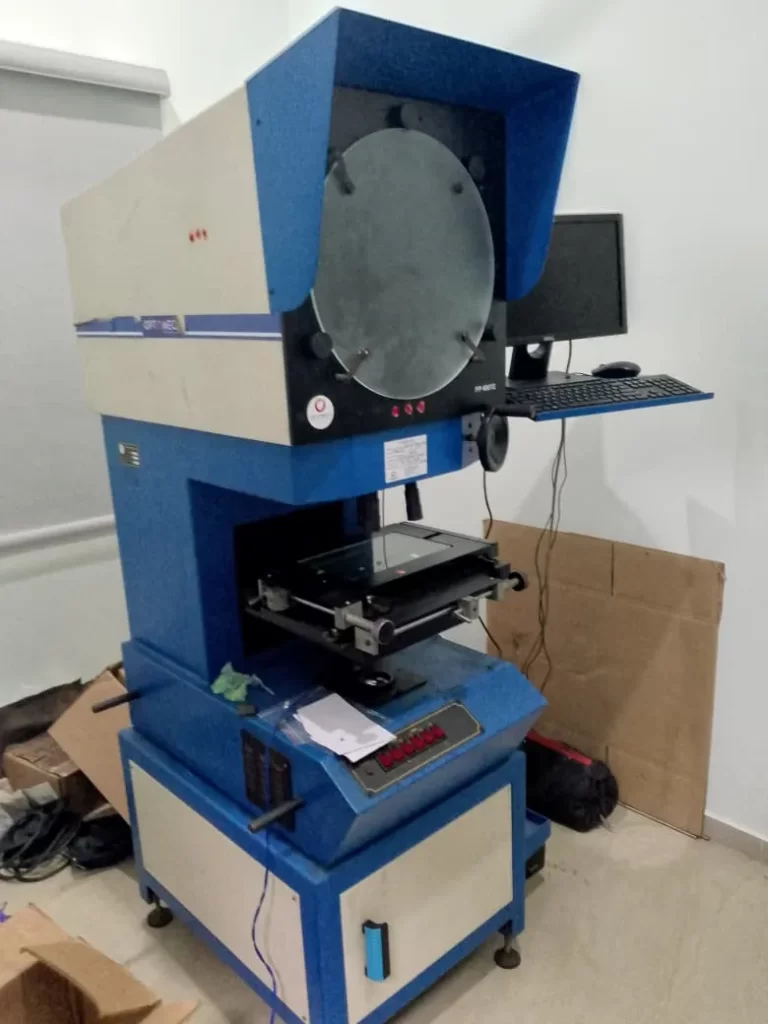
What are Dimensional Measurements?
Dimensional measurement is the process of accurately determining the size, shape, and geometry of a component. It ensures that manufactured parts meet precise specifications and tolerances required for proper function, fit, and performance.
In simple terms, dimensional measurement confirms that every product is “made exactly as designed.”
Purpose of Dimensional Measurement
The goal of dimensional measurement is to verify the accuracy, uniformity, and consistency of parts and assemblies. It plays a vital role in quality control, research and development, and product validation.
Dimensional measurements help:
Verify part conformity to drawings or CAD models
Identify deviations, wear, or deformation
Support reverse engineering and failure analysis
Maintain manufacturing precision and process control
Types of Dimensional Measurement Methods
- Linear Measurements – Length, width, height, thickness, and diameter using micrometers, vernier calipers, or height gauges.
- Geometric Measurements – Flatness, roundness, cylindricity, and parallelism using coordinate measuring systems.
- Coordinate Measuring Machine (CMM) Testing – High-precision 3D measurements with automated probes for complex geometries.
- Optical and Vision Measurement Systems – Non-contact methods using laser and camera sensors for small or delicate components.
- Surface and Profile Measurement – Assessment of surface finish, contour, and roughness.
Applications of Dimensional Measurements
Dimensional accuracy is crucial in industries where tight tolerances are required, such as:
- Automotive: Engine parts, gears, and shafts
- Aerospace: Structural components and assemblies
- Manufacturing: Precision tools, dies, and machined parts
- Defense: Weapon and vehicle component validation
- Electronics: Connectors, housings, and miniature components
Our Dimensional Measurement Capabilities
At Measure India Corporation Pvt. Ltd., we offer advanced Dimensional Measurement Services using high-accuracy instruments and CMM technology.
Our capabilities include:
- 2D and 3D coordinate measurements
- Reverse engineering and CAD comparison
- Surface and contour measurement
- Calibration traceable to NABL / ISO 17025 standards
Our skilled metrology experts ensure precise, reliable, and traceable results to support your product development, inspection, and certification needs.
Tensile Testing Sample Preparation – FAQs
Looking for Dimensional Measurement testing services in India? Get accurate, NABL-certified material testing with advanced Universal Testing Machines (UTMs) today!
1. What is dimensional measurement testing?
Dimensional measurement testing checks the size, shape, and geometric accuracy of a component to ensure it meets design specifications.
2. Why is dimensional inspection important?
It ensures proper fit, function, and interchangeability of parts, reducing assembly problems and product failures.
3. What instruments are used for dimensional measurement?
Common tools include CMM (Coordinate Measuring Machine), Vernier calipers, micrometers, height gauges, dial gauges, and profile projectors.
4. What is a CMM machine?
A CMM automatically measures component dimensions in 3D with high accuracy using a probe system and software analysis.
5. What types of measurements are checked?
Length, diameter, thickness, angles, flatness, roundness, concentricity, perpendicularity, and geometric tolerances.
6. What industries require dimensional testing?
Automotive, aerospace, medical devices, defense, manufacturing, electronics, and construction industries.
7. What standards are followed in dimensional measurement?
Common standards include
International Organization for Standardization – ISO 1101, ISO 2768
Bureau of Indian Standards – IS measurement standards
ASTM International – relevant ASTM inspection standards.
8. Where can we get dimensional testing services?
Accredited labs like Measure India Corporation Pvt. Ltd. provide accurate dimensional inspection with calibrated equipment and detailed reports.
Roughness Measurements
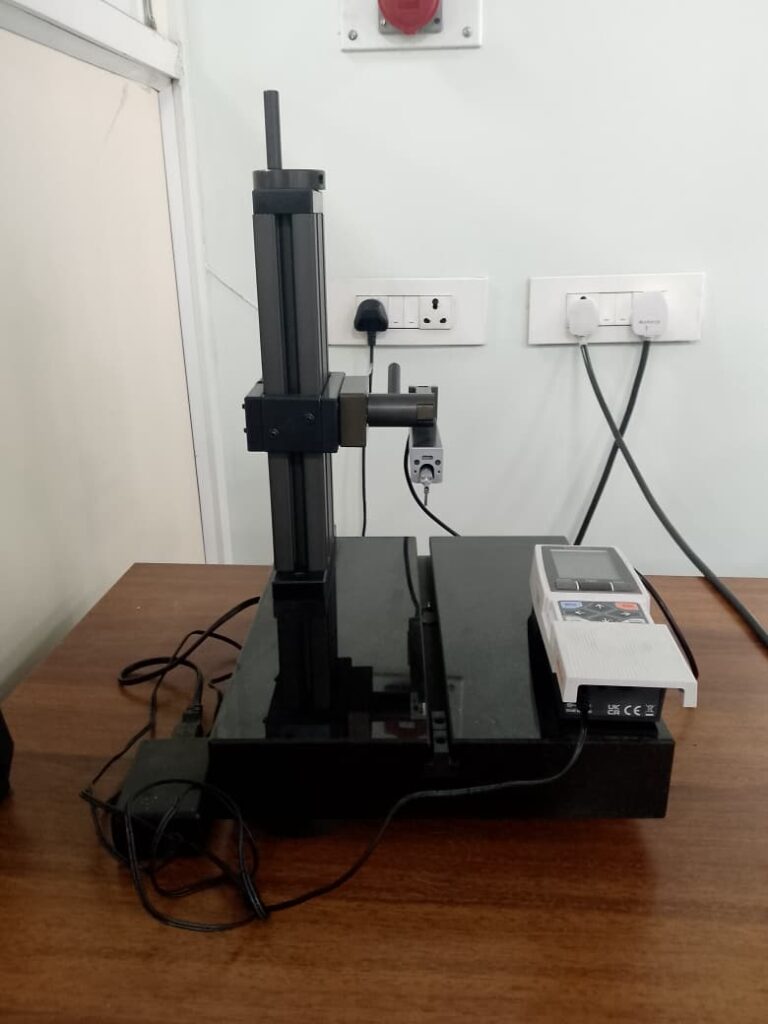
What are Roughness Measurements?
Surface roughness refers to the minute irregularities or deviations found on a material’s surface. These irregularities can affect how a part performs, wears, or interacts with other components. Measuring surface roughness is essential for ensuring proper fit, function, lubrication, and aesthetic quality of a product.
Purpose of Roughness Measurement
Roughness measurement determines how smooth or rough a surface is, and whether it meets the required surface finish standards.
It helps manufacturers and engineers:
- Evaluate the quality of machined or finished components
- Control manufacturing processes and tool performance
- Ensure components meet design tolerances
- Improve product durability, efficiency, and appearance
Surface Roughness Parameters
Some common roughness parameters include:
- Ra (Roughness Average): The average deviation from the mean line — most commonly used.
- Rz (Mean Peak-to-Valley Height): The average difference between highest peaks and lowest valleys.
- Rt (Total Roughness): The overall height difference across the entire sample.
- Rq (Root Mean Square Roughness): The square root of the mean of squared deviations.
These parameters help quantify and compare surface textures across different components and materials.
Methods of Roughness Measurement
Contact Method (Stylus Profilometer)
- A diamond-tipped stylus moves across the surface to record irregularities.
- Highly accurate for metals, plastics, and machined surfaces.
Non-Contact Method (Optical/3D Profilometer)
- Uses light or laser-based sensors to scan the surface.
- Ideal for delicate or soft materials where contact may cause damage.
Applications of Roughness Measurement
Roughness testing is widely used in industries where surface quality affects performance, such as:
- Automotive: Bearings, pistons, and sealing surfaces
- Aerospace: Turbine blades, structural parts, and fasteners
- Manufacturing: Tool and die inspection, machined parts
- Medical Devices: Implants and surgical instruments
- Electronics: Connectors, coatings, and micro-components
Our Roughness Measurement Capabilities
At Measure India Corporation Pvt. Ltd., we offer high-precision Surface Roughness Measurement Services using both contact and non-contact methods.
Our advanced instruments can measure parameters like Ra, Rz, Rt, and Rq, ensuring full compliance with ISO 4287, ISO 25178, and ASME B46.1 standards.
Our services include:
- Surface finish analysis for machined and coated parts
- Profile, contour, and waviness measurement
- 2D and 3D roughness mapping
- Detailed inspection reports with graphical output
We ensure accurate, repeatable, and traceable surface finish results to support your product development, quality assurance, and process optimization.
Roughness Measurement Testing Sample Preparation – FAQs
Looking for Roughness Measurement testing services in India? Get accurate, NABL-certified material testing with advanced Universal Testing Machines (UTMs) today!
1. What is surface roughness testing?
Surface roughness testing measures the texture of a surface to evaluate its smoothness and finish quality.
2. Why is roughness measurement important?
Because surface finish affects friction, wear, sealing ability, coating adhesion, fatigue life, and overall product performance.
3. What parameters are measured in roughness testing?
Common parameters include Ra (average roughness), Rz (maximum height), Rt, Rq, and waviness values.
4. What instruments are used for roughness testing?
Profilometers, portable roughness testers, optical roughness testers, and comparison specimens are commonly used.
5. What is Ra value?
Ra is the arithmetic average of surface deviations from the mean line and is the most widely used roughness parameter..
6. Which industries need surface roughness testing?
Automotive, aerospace, machining, medical devices, tool manufacturing, bearings, and precision engineering industries.
7. What standards are followed in roughness measurement?
Testing is done as per
International Organization for Standardization – ISO 4287 / ISO 4288
Bureau of Indian Standards – IS roughness standards
ASTM International – ASTM surface finish standards.
8. Where can I get roughness testing services?
Accredited labs like Measure India Corporation Pvt. Ltd. provide accurate roughness measurement with calibrated instruments and professional reporting.
Registration & Certifications
We are a certified and registered organization committed to quality and compliance.

Accredited by NABL
(National Accreditation Board for Testing and Calibration Laboratories – India)
Our laboratory is accredited by NABL as it meets international standards for quality and competence.
It operates in accordance with ISO/IEC 17025:2017. NABL accreditation is recognized
both nationally and internationally.
If you are looking for NABL-accredited testing laboratories in India, our facility provides high-precision testing services in compliance with global quality standards
- Tensile Testing: ASTM E8M, ASTM E21, ASTM B557M, ASTM A770, ASTM D3039M, ASTM D412, ASTM D638, IS 1608 (Part-1, Part-3), ISO 6892
- Compression Testing: ASTM D575
- Bend Testing: ASTM E290, IS 1599
- Low Cycle Fatigue Testing: ASTM E606
- High Cycle Fatigue Testing: ASTM E466
- Fatigue Crack Growth Rate Testing: ASTM E647
- Fracture Toughness Testing (KIC): ASTM E399
- Fracture Toughness Testing (JIC): ASTM E1820
- Creep & Stress Rupture Testing: ASTM E139, ASTM E292
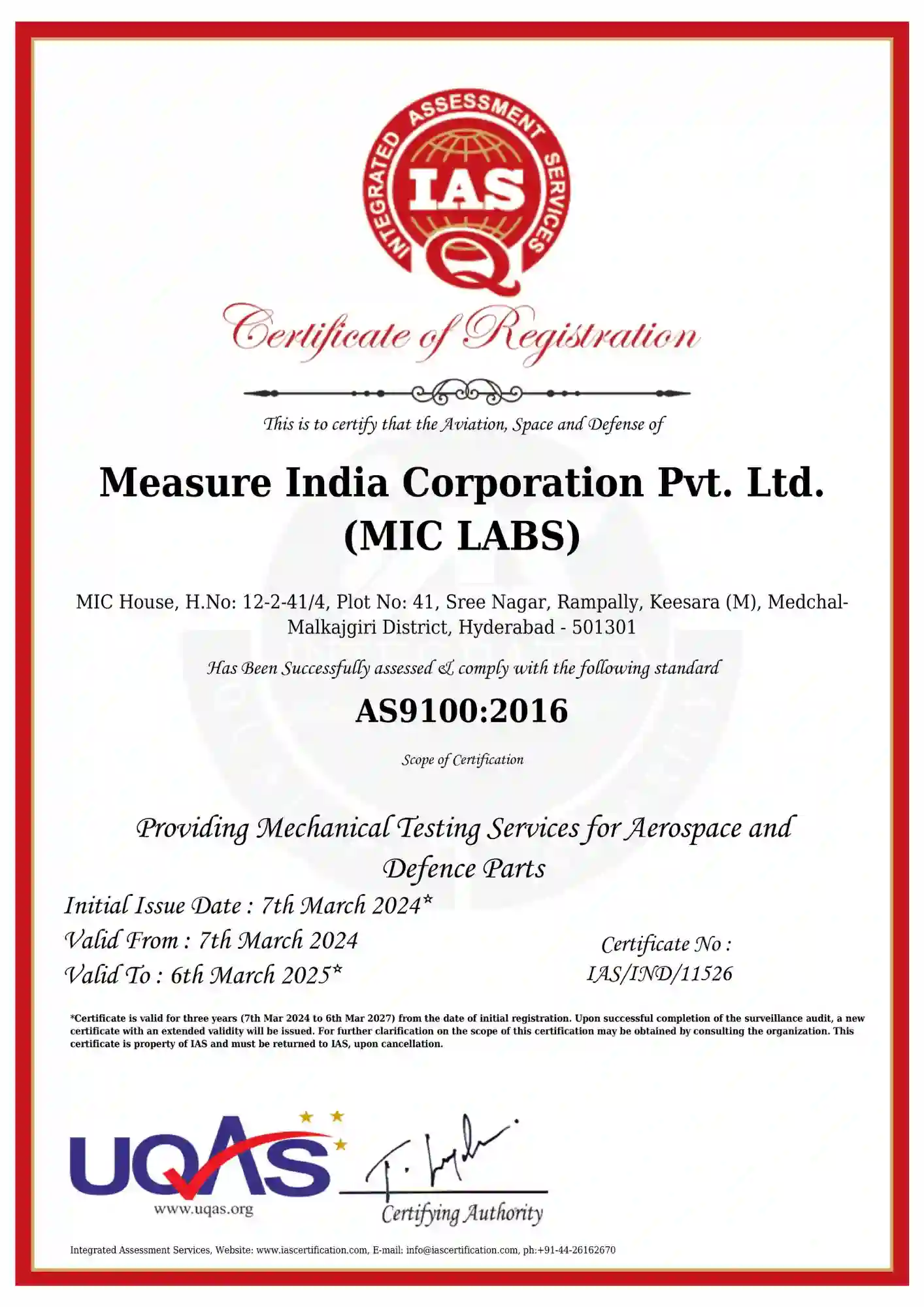
AS9100:2016 Certified
MIC Labs is certified by IAS in accordance with AS9100:2016, meeting international aerospace quality standards.
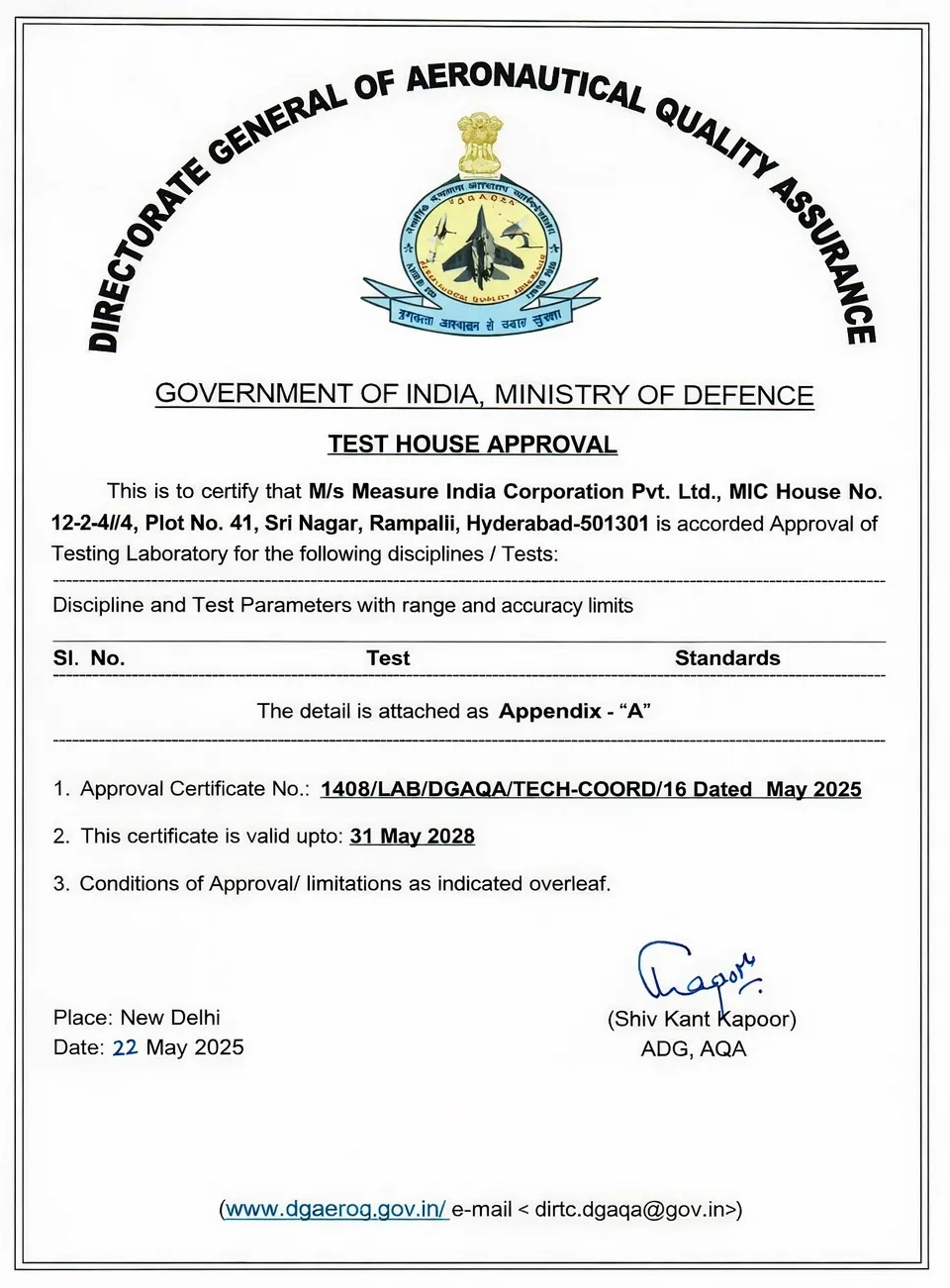
Approved by DGAQA
MIC Labs is approved by DGAQA, ensuring compliance with aerospace and defense testing requirements.

Registered by UDYAM
Measure India Corporation Pvt Ltd is UDYAM registered, recognizing us as a certified MSME in India.
This registration highlights our commitment to quality, statutory compliance, and industry standards.
Why Choose Us
We have 20 years of experience in providing material testing systems and offering testing services with great confidence.
- 90+ Products
- 500+ Customers
- 35+ Team Size
- Expertise in guiding and working with top-notch researchers and engineers
- World-class mechanical testing laboratory
Mechanical Testing Lab Services & Universal Testing Machines Suppliers in India
“With over 20 years of experience, Measure India Corporation Pvt Ltd supplies Universal Testing Machines & mechanical testing services, ensuring precision, reliability, and compliance with ASTM, ISO, and global standards across various industries.”

















Contact Information
9:00 AM – 5:30 PM
Sreenagar, Rampally,
Hyderabad, Telangana 501301
Get In Touch With Us
Please fill out the form below and a member of our team will respond promptly.