

Accurately predicts low-temperature cracking behavior. Improves pavement life and reduces early road failures. Ensures compliance with international pavement test standards.Speeds up new binder qualification and development.Provides highly repeatable and operator-independent results.Enhances reliability of asphalt performance grading.
Mechanical Testing Equipment
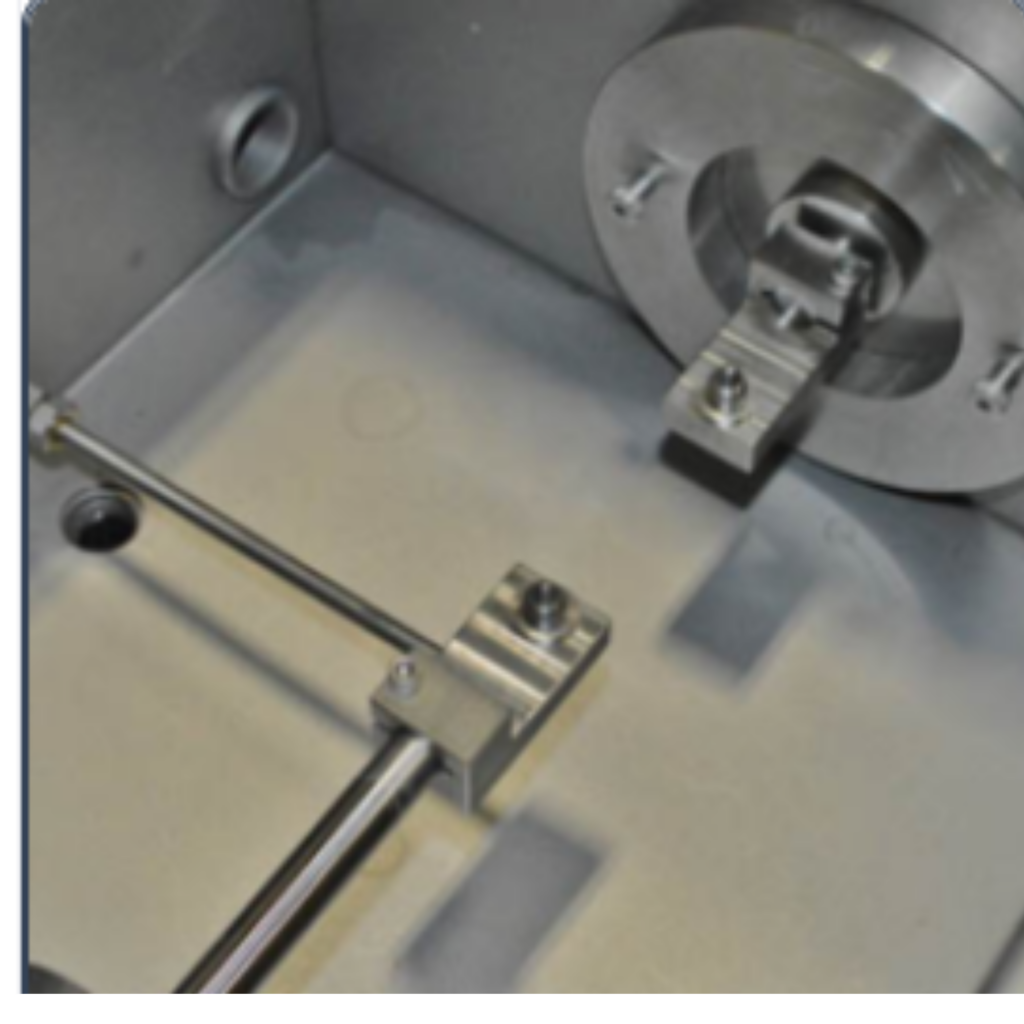
Interlaken Direct Tension Tester (DTT)
Interlaken Technology designs Hydraulic Presses: ServoPress, Hydroforming and Heat form
The Interlaken Direct Tension Tester (DTT) from Interlaken Technology Corporation is a precision laboratory testing system developed to evaluate the low-temperature tensile and fracture properties of asphalt binders and similar viscoelastic materials. The system is widely used to predict cracking resistance and durability of road construction materials under cold climatic conditions.
Category:
The Direct Tension Tester is a specialized mechanical testing machine that applies a controlled uniaxial tensile load to a prepared “dog-bone” shaped asphalt or binder specimen at low temperatures until failure occurs. The test directly measures how much stress and strain the material can withstand before cracking.
In simple terms, it helps pavement engineers predict low-temperature cracking behavior of asphalt binders before actual road construction.
Servo-hydraulic / servo-electric loading system for precise dent force control
Closed-loop control for accurate and repeatable dent depth measurement
High-precision load cell & displacement sensors for accurate dent depth data
Computer-controlled testing with real-time data acquisition
Automatic test modes with programmable load and speed settings
Interchangeable indenters / tooling for different dent standards
Rigid frame construction for stable and vibration-free testing
Integrated software for analysis, reporting, and data storage
Compliance with international standards for dent resistance testing
Safety interlocks and emergency stop system
Load capacity: 1 kN to 5 kN (binder testing range).
Displacement control resolution: High precision servo control.
Test temperature range: Sub-zero to ambient (with temperature bath).
Specimen type: Standard dog-bone asphalt binder samples.
Control mode: Displacement or strain controlled.
Data output: Stress–strain curve, failure stress, failure strain, fracture energy.
Software: PC-based data acquisition and reporting system.
Low-temperature performance grading of asphalt binders.
Research on polymer-modified and specialty binders.
Quality control in pavement material testing laboratories.
Government and academic research on road durability.
Performance comparison of different binder suppliers.
Failure analysis of asphalt cracking problems.
1.What is the main purpose of the Interlaken DTT?
To evaluate the low-temperature tensile and cracking behavior of asphalt binders.
2. Which industry mainly uses the DTT system?
Road construction, pavement engineering, academic research and quality control labs.
3.Does the DTT test asphalt mixes or only binders?
It is primarily designed for asphalt binder testing.
4. Why is low-temperature testing important?
It helps prevent thermal cracking and premature pavement failure.
5.Is the system fully automated?
Yes, it uses servo-controlled motion with software-based control and data logging.
6.What type of output does the DTT generate?
Stress–strain curves, failure stress, failure strain and fracture energy.
7.Stress–strain curves, failure stress, failure strain and fracture energy.
Yes, standardized dog-bone samples are required for accurate testing.
8.Can polymer-modified binders be tested?
Yes, the system is widely used for modified and specialty binders.
9.Does the DTT replace field performance testing?
No, it supports laboratory prediction but does not replace field validation.
10.Is customization available from Interlaken?
Yes, temperature range, load capacity and software features can be customized.