

The process must be carefully controlled — incorrect pressure profiles can overstrain or damage parts.
Not ideal for brittle materials that cannot plastically deform without cracking. Material selection and design must be validated before autofrettage.
Post-process machining or treatments must account for induced residual stresses
Mechanical Testing Equipment
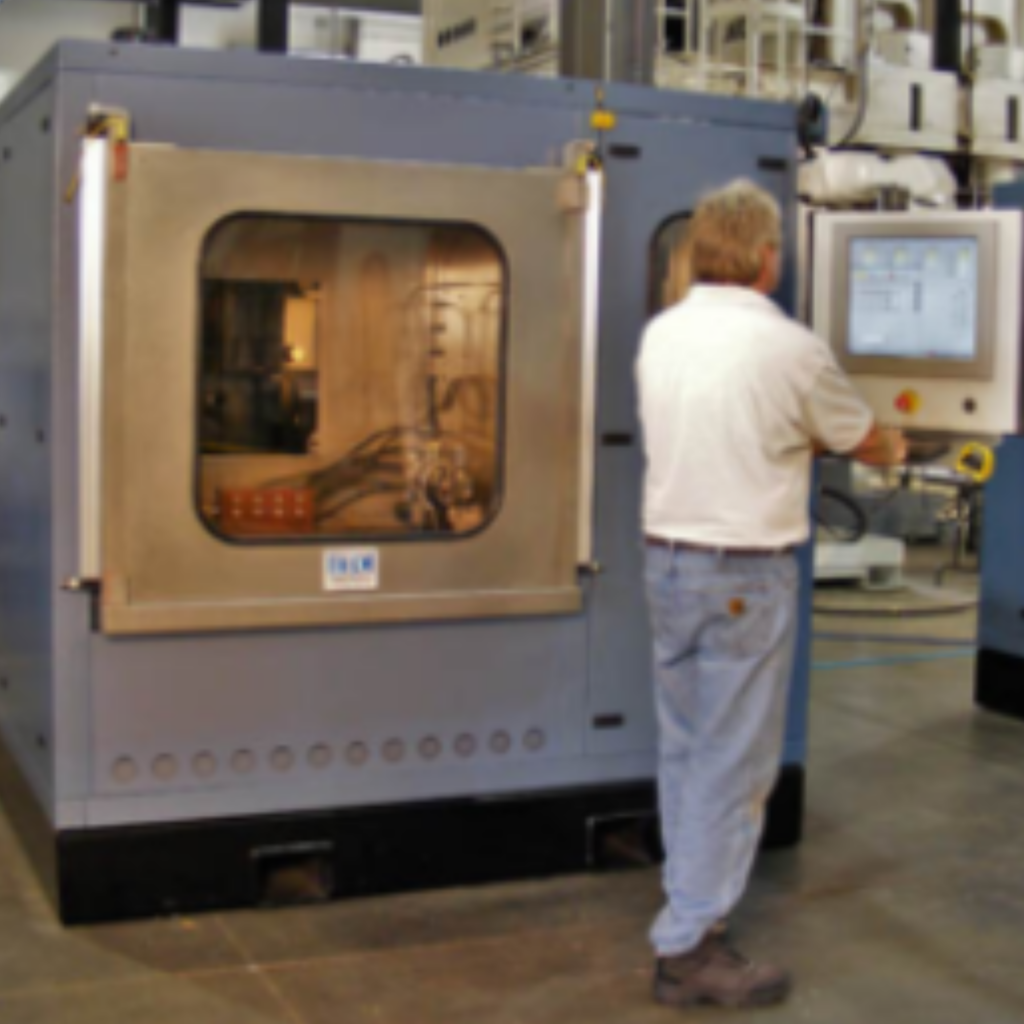
Interlaken Autofrettage Machine
Interlaken Autofrettage Machine suppliers all over India
The Interlaken Autofrettage Machine is a high-pressure hydraulic system designed to perform controlled autofrettage on thick-walled tubes and pressure components. By applying internal pressure beyond the elastic limit at the bore and then releasing it, the process produces permanent compressive residual stresses at the inner surface — greatly improving fatigue life, crack-resistance, and the allowable working pressure of components such as fuel rails, pump housings, hydraulic cylinders and other pressure vessels.
Category:
Interlaken’s autofrettage systems form part of their high-pressure and hydraulic equipment portfolio. The machine uses hydraulic intensifiers and a programmed pressure profile to plastically yield the inner layers of a component while keeping outer layers elastic. After depressurization, the residual stress state remains — allowing manufacturers to design lighter or longer-lasting parts and to increase safety margins for cyclic/high-pressure service.
Benefits
Improves fatigue life and resistance to crack initiation at the bore, increasing component reliability and service life. Allows material and weight savings by enabling thinner walls or alternative designs while keeping required safety margins.
Provides documented, repeatable processing with data logging for traceability and quality control.
Adaptable from R&D to serial production via tooling and automation options.
Interlaken-style autofrettage systems typically include:
Interchangeable fixtures and custom adaptors for different component geometries (rails, tubes, housings).
High-pressure intensifiers capable of reaching industrial autofrettage pressures (configurable to customer requirements).
Closed-loop programmable controllers with HMI for pressure ramp profiles, monitoring and data logging.
Safety enclosure with interlocks, pressure and leak sensors and emergency shutdown.
Options for single-chamber R&D rigs or multi-chamber, semi-automated production benches for high throughput.
1. What is dimensional measurement testing?
Dimensional measurement testing checks the size, shape, and geometric accuracy of a component to ensure it meets design specifications.
2. Why is dimensional inspection important?
It ensures proper fit, function, and interchangeability of parts, reducing assembly problems and product failures.
3. What instruments are used for dimensional measurement?
Common tools include CMM (Coordinate Measuring Machine), Vernier calipers, micrometers, height gauges, dial gauges, and profile projectors.
4. What is a CMM machine?
A CMM automatically measures component dimensions in 3D with high accuracy using a probe system and software analysis.
5. What types of measurements are checked?
Length, diameter, thickness, angles, flatness, roundness, concentricity, perpendicularity, and geometric tolerances.
6. What industries require dimensional testing?
Automotive, aerospace, medical devices, defense, manufacturing, electronics, and construction industries.
7. What standards are followed in dimensional measurement?
Common standards include
International Organization for Standardization – ISO 1101, ISO 2768
Bureau of Indian Standards – IS measurement standards
ASTM International – relevant ASTM inspection standards.
8. Where can we get dimensional testing services?
Accredited labs like Measure India Corporation Pvt. Ltd. provide accurate dimensional inspection with calibrated equipment and detailed reports.
Pull these values as a starting point — actual Interlaken model specs will vary by configuration and customer needs.
Maximum autofrettage pressure: commonly 8,000–12,000 bar (some systems up to or beyond these values with special intensifiers).
Pressure generation: hydraulic intensifier(s) driven by HPU.
Control: closed-loop / programmable pressure profiles, HMI and data logging.
Chamber configurations: single to multi-chamber (production rigs support multiple lines/chambers).
Footprint & installation: depends on capacity — from compact lab rigs to larger production stands; includes safety enclosure.
Interlaken hydroforming press machines areAutofrettage machines are used where components face repeated internal pressure or require high burst/fatigue strength: fuel injection rails and lines; high-pressure hydraulic cylinders; pump housings and valve bodies; pressure-containing parts for oil & gas, aerospace and heavy equipment. The process is widely adopted where life extension and safety under cyclic loading is critical. available in a wide range of tonnage capacities starting from small laboratory systems around 50 tons to heavy industrial presses exceeding 2000 tons. These systems support high-pressure forming operations typically ranging from several hundred bar to above 4000 bar depending on application requirements. The machines are compatible with a wide range of materials including mild steel, stainless steel, aluminum alloys, titanium, copper, and special high-strength alloys. Tube diameter, wall thickness, stroke length, and press bed size can be custom engineered as per customer requirements. The control system supports PLC or CNC-based integration with real-time pressure, force, displacement, and cycle monitoring.
Benefits
By using Interlaken hydroforming technology, manufacturers in Hyderabad can significantly reduce the number of welded joints in their products, resulting in higher structural strength and improved fatigue life of components. The process reduces material wastage and improves material utilization, leading to lower overall manufacturing costs. Hydroforming enables lightweight design without compromising strength, which is especially beneficial for automotive and aerospace applications. Production consistency and dimensional accuracy are greatly improved, minimizing rejection rates and rework. The ability to form complex shapes in a single operation also shortens production cycles and increases overall manufacturing efficiency.
1. What does an autofrettage machine do?
It applies internal pressure to plastically deform inner layers of a component and induce beneficial compressive residual stresses at the bore.
Which components benefit most from autofrettage?
High-pressure fuel rails, hydraulic cylinders, pump housings, valves and other thick-walled pressure components.
3. What pressure levels are typical?
Industrial rigs commonly operate in the 8,000–12,000 bar range; exact values depend on part geometry and material.
4.Is the process automated?
Systems range from manual/lab rigs to fully automated multi-chamber production benches.
5.What safety features are included?
Pressure enclosures with interlocks, leak detection, pressure sensors and emergency shutdown are standard.
6. Can autofrettage replace heat treatment?
No — it’s complementary. Autofrettage modifies residual stress distribution; heat treatment affects microstructure and hardness. Each serves different purposes.
7. Will autofrettage change component dimensions?
Yes — because plastic deformation occurs; tolerances and any post-process machining must be planned accordingly.
8.Is it suitable for aluminum or exotic alloys?
Ductile alloys that can plastically deform are candidates; feasibility depends on material properties and part geometry.
9.Can Interlaken supply fixtures and tooling?
Yes — vendors typically provide custom fixtures, adaptors and automation options to match your components.
10.How do I qualify the process?
Run test cycles with instrumentation (pressure vs time, strain where possible), inspect residual stress/geometry, then validate with fatigue/burst testing per your specifications.